Sunday, July 5, 2026
spot_img
Home Blog Page 111

Cosmo Plastech Attains Globally Recognized FSSC 22000 For Food Packaging.

Cosmo Plastech Attains Globally Recognized FSSC 22000 For Food Packaging

  • FSSC 22000 (Food Safety System Certification) has requirements on food waste for delivering on UN SDG commitments.
  • Cosmo Plastech is into rigid sustainable packaging solutions servicing Food Packaging, FMCG, Electronics, Food Outlets etc.

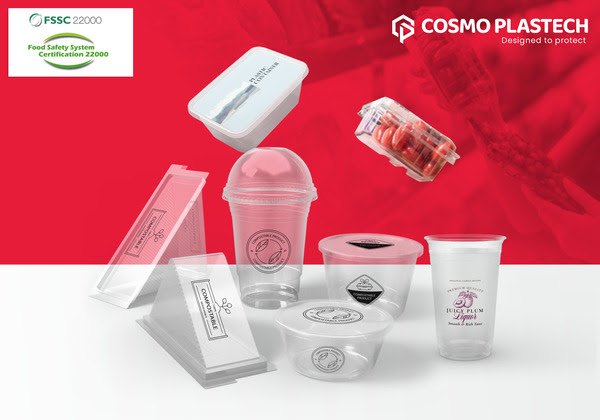
Cosmo First Ltd. is pleased to announce that Cosmo Plastech (rigid sheets, Thermoforming & Injection Molding) has attained the FSSC 22000 food safety certification, a mandatory requirement for the packaging material coming in direct contact with food. FSSC 22000 contains requirements that help companies address risk in multiple areas from food fraud, food defense, food safety and quality culture, quality control, allergen management and environmental monitoring programs.

This certification is based on the existing internationally recognized standard ISO 22000 and complemented by technical standards, such as ISO TS 22002-1 for food manufacturing and ISO TS 22002-4 for packaging manufacturing. Further, this is also consistent with other standards, such as ISO 9001 and ISO 14001 (including the alignment with ISO High Level Structure).

The FSSC 22000 certification includes several benefits for the company and stakeholders such as:

  • Commitment to identify, evaluate, and control food safety hazards to avoid consumer harm directly or indirectly.
  • Helps in meeting food quality/safety requirements and legal compliance.
  • Provide a tool for food safety performance improvement, and the means to monitor and measure food safety performance effectively.
  • Develop a good food safety culture which in turn improves customer confidence and aids in acquiring competitive advantages.

Sharing his views on the certification, Mr. Pankaj Poddar, Group CEO, Cosmo First Limited The Global market is distinguished by its significant youth population, leading to a booming demand for fast food and packaged food. This trend indicates substantial growth potential for the food packaging sector. Therefore, obtaining the FSSC 22000 certification is a positive step for us as a group, enabling enhanced service to the industry.”

Commenting on this achievement, Mr. Sanjay Chincholikar, Business Head – Rigid Packaging said, “Achieving FSSC 22000 certification exemplifies our commitment to food safety and quality. Earning this rigorous accreditation required demonstrating a systematic and meticulous approach to food packaging production. We understand the critical role food packaging plays in safeguarding public health. By achieving FSSC 22000 certification, we take a proactive stance in guaranteeing the safety of both our clients and their end consumers.”

The Food Safety System Certification FSSC 22000 is applicable for the scope of sheet extrusion, thermoforming, injection molding, dry offset printing and/or sleeving of PP & HIPS based rigid plastic cups, lids, trays and sheets for food packaging application.

https://www.cosmofirst.com/

#modernplasticsindia #indianplasticmagazine #modernplasticsaward #plasticnews #modernplasticsgermany #ginujoseph #modernplastic #plasticindia  #plasticrecycling #sustainability #modernplasticsglobalnetwork #modernglobalnetwork #modernplasticsaward2023 #plasticmagazine #PlasticIndustry  #modernplasticsmiddleeast #indianmagazine #innovations #modernplasticsamerica #modernplasticsbangladesh #modernplasticsasia #modernplasticsitaly  #cortecadvertising

Packaging Specialist ALPLA Is Investing In Morocco And Planning Expansion

Packaging Specialist ALPLA Is Investing In Morocco And Planning Expansion

The internationally active ALPLA Group is expanding its presence in North Africa with its market entry in Morocco and setting the course for growth in the Maghreb. The plastic packaging specialist has acquired a majority stake in the packaging producer Atlantic Packaging and founded the joint venture ALPLA Morocco with the previous sole owner Diana Holding. In addition to PET preforms for the beverage industry, plastic pallets and films are produced at the plant in Tangier. Preform production has recently been tripled through investments in new machinery.

In its ongoing international expansion efforts, ALPLA now also provides safe, affordable and sustainable plastic packaging solutions in Morocco. By acquiring a majority stake in the packaging company Atlantic Packaging and establishing a joint venture with the previous sole owner Diana Holding, ALPLA is contributing its expertise and experience to the production of PET preforms for the regional markets in the Maghreb and for Western Africa. In addition to preforms, ALPLA Morocco also produces plastic pallets by injection moulding and packaging films by extrusion at its modern plant in Tangier. Currently, 32 people are employed at the site.

ALPLA Morocco’s preform capacity has already been tripled in 2023 by two additional preform production lines. In the coming years, ALPLA is committed to increasing the portfolio of the Moroccan site through further local activities, potentially including bottle and closure production. This initiative aims to establish the groundwork for growth and sustainable packaging solutions in the North Western African Region.

Strategic partnership

‘Together with our strategic partner Diana Holding, we want to exploit the enormous potential of the regional markets, open up new segments and contribute our expertise as a global system provider for preforms, bottles and closures,’ explains Christian Fessler, Managing Director Middle East and North Africa at ALPLA.

In addition to its packaging subsidiary, Diana Holding is primarily active in the agro-industrial sector. Through this joint venture, the family-run group is strengthening its packaging division, which was founded in 2007, by capitalising on its substantial bottling experience garnered over nearly 50 years as the former Coca-Cola Company bottler in the northern region of Morocco.

‘Our joint vision is to be one of the leading suppliers of high-quality plastic packaging in Morocco and for Western Africa, and to offer innovative solutions. We created Atlantic Packaging with the vision of expanding its capacity through a strategic partnership. In ALPLA, which puts a great emphasis on the three P’s: People, Planet, Profit, we have found the ideal partner for this project, enabling the creation of further synergies,’ says Rita Maria Zniber, CEO of Diana Holding.

Production capacity tripled

The approximately 12,000 square metre plant in the free trade zone of Tangier is to be expanded in stages over the coming years. More than 20,000 square metres of space is available for future expansion. In the first stage, ALPLA Morocco has tripled its production capacity from the current 100 million preforms to around 300 million units per year. To this end, the company is investing in two new PET preform production lines.

‘Through the location in Morocco, we can supply our global customers in northern Africa with the usual quality and flexibility, gain new business partners and expand our portfolio to include new areas. At the same time, we are creating new jobs by expanding our production volume,’ says Javier Delgado, ALPLA Regional Managing Director Africa, Middle East and Turkey.

In addition to the know-how for the development and production of resource-saving plastic packaging made of recycled material, ALPLA Morocco is looking ahead to leverage its capabilities as a system provider and to introduce new technologies in the future. ‘By manufacturing bottles, preforms and closures, as we already do in South Africa and Angola, we provide customers with successful products and sustainable solutions from a single source, giving them a market advantage,’ says Delgado.

The joint venture was signed by the contracting parties on 31 August 2023, and approved by the local antitrust authorities. The parties have agreed not to disclose the terms and conditions.

www.alpla.com

#modernplasticsindia #indianplasticmagazine #modernplasticsaward #plasticnews #modernplasticsgermany #ginujoseph #modernplastic #plasticindia  #plasticrecycling #sustainability #modernplasticsglobalnetwork #modernglobalnetwork #modernplasticsaward2023 #plasticmagazine #PlasticIndustry  #modernplasticsmiddleeast #indianmagazine #innovations #modernplasticsamerica #modernplasticsbangladesh #modernplasticsasia #modernplasticsitaly  #cortecadvertising


Light And Sound Management Through The Use Of Next Generation Photo-Chemical Etching

Light And Sound Management Through The Use Of Next Generation Photo-Chemical Etching

This article looks at the unique characteristics of photo-chemical etching (PCE) and how it allows for the production of very thin filters with variable hole geometries that can be varied within a single pattern. This allows its creative use in the management of light and sound in a variety of applications.

 LIGHT MANAGEMENT 

Light transmission and attenuation, especially angle-dependent, can be difficult to manage depending on the size limitations and space constraints available. The unique characteristics of PCE — enhanced by micrometal  allow for the production of very thin metal panels that can transmit, attenuate, block, and even focus or re-direct light depending upon incoming angle.  All with no moving parts or power requirements. Light transmission of up to 90%, and near-complete attenuation can be achieved in the same panel, and creative design options can enable unique manipulation of light.

Thin filters with holes of varying angles, shapes, and patterns, crafted through PCE offer innovative solutions for advanced light management. The ability to design holes with multiple geometries and angles within a single pattern or array on a panel enables the manipulation of light in complex and highly specific ways. For example, varying hole angles can influence the directionality of light, allowing for beams to be blocked, refracted or reflected in targeted directions. Different hole shapes and patterns can control the intensity, diffusion, and spread of the transmitted light. A great example is lamination of these types of panels on top of or within window glass, where sunlight can be blocked at peak times of day and allowed to pass at others, minimizing heating and cooling costs.

When these filters are applied in optical systems, displays, or advanced lighting setups, they can provide tailored illumination profiles, precise beam shaping, and controlled light dispersion. The ability to have diverse hole shapes and angles within one pattern can also be critical in applications like spectrometry, where light must be separated into its constituent wavelengths in specific patterns.

PCE is a superior technology choice for producing such intricate filters due to its unmatched precision and adaptability. Unlike mechanical methods, which can struggle with maintaining accuracy over complex patterns, PCE uses a chemical process that can faithfully reproduce even the most intricate designs without inducing mechanical stress or deformation. The process is also burr-free, ensuring that the edges of the holes are clean, which is crucial for precise light management. Furthermore, PCE can handle diverse metals, granting designers the flexibility to select materials based on their individual mechanical properties. The combination of precise design replication, clean etching results, and versatility in material selection makes PCE the go-to choice for creating high transmission thin wall filters with multifaceted hole configurations for sophisticated light management applications.

Such thin wall filters with intricate hole geometries can be employed to create light patterns on surfaces or to produce visual effects. When sunlight or artificial light sources pass through these filters, the variable angles, shapes, and patterns of the holes dictate how the light will be dispersed or concentrated upon emerging from the filter. This results in myriad possible patterns or effects on the receiving surface, ranging from focused beams to intricate shadows or diffused light gradients. The diversity of hole designs within a single filter can further enrich the resultant patterns, enabling the creation of complex and dynamic visual experiences. Such capabilities can be advantageous in architectural designs for decorative illumination, in theatrical productions for mood lighting, or even in commercial spaces where unique lighting can enhance branding or ambiance. The precision and customization offered by these filters make them powerful tools in the hands of designers and artists looking to harness light in novel and impactful ways.

Closely spaced precision holes in filters, crafted through techniques like PCE can also serve as locators or guides for micro light sources in high-resolution displays. Such configurations can be instrumental in microLED or miniLED display technologies where individual tiny LEDs act as the pixels. By aligning each microLED with the precisely etched holes, designers can ensure uniformity in light emission, optimize pixel density, and achieve superior control over each light source. This precision alignment becomes particularly critical in high-resolution displays where the spacing and consistency of micro light sources directly influence the display’s clarity, colour accuracy, and overall performance. In essence, filters with closely spaced holes can act as templates or frameworks, facilitating the meticulous arrangement of micro light sources required in cutting-edge display technologies.

Finally, the fact that our next generation PCE process can also process thin sheet metal materials offer distinctive advantages when fashioned into filters for light management. Their inherent flexibility and minimal thickness allow these filters to seamlessly adhere to curved surfaces, expanding the scope of their applications. In scenarios like automotive displays, wearable technology, or architectural lighting, the ability to conform to non-linear and intricate designs is invaluable. Beyond aesthetic considerations, the slim profile of these materials ensures that they occupy minimal space, making them particularly suited for compact devices or installations where bulkiness could compromise functionality or design integrity.

SOUND MANAGEMENT

OK, we heard you. What about managing sound?

Thinking this through, we certainly believe filters crafted with precise holes and patterns, similar to those discussed for light management, can also find utility in acoustic applications.  When applied to sound waves, these filters can act as acoustic meta-surfaces or diffusers, selectively attenuating or redirecting sound from specific angles.

The intricacy of the hole patterns can influence the manner in which sound waves interact with the filter, allowing for the manipulation of acoustic wavefronts. By strategically designing these filters, it becomes feasible to sculpt the acoustic landscape, isolating or emphasizing sounds from particular directions or frequencies. Such capabilities can be pivotal in environments that demand precise acoustic control, be it in sound studios, concert halls, or noise-sensitive industrial settings. Thus, while primarily conceptualized for light, the versatile design principles behind these filters can be innovatively repurposed for sound modulation.

It is also possible that thin filters with meticulously crafted hole geometries and through-angles could also have a pronounced effect on sound wave propagation, particularly in distinguishing between different frequencies. Depending on the size, shape, and orientation of the holes, these filters could act as selective barriers, allowing specific frequencies to pass while attenuating others. For instance, larger hole dimensions might permit lower frequencies to pass, whereas intricate or smaller hole geometries might deflect or attenuate them. Conversely, higher frequencies, with their shorter wavelengths, could either be allowed to pass or be attenuated based on the designed hole characteristics. The through-angle, or the orientation of the holes, could further influence the directionality of both incoming and outgoing sound waves, enabling the redirection of specific frequencies. This frequency-selective behaviour, achieved through tailored filter designs, could be invaluable in applications such as acoustic engineering, speaker design, and noise control, offering a nuanced approach to sound management.

Indeed, thinking outside the box, for acoustic applications, high transmission thin wall filters could be discreetly mounted behind other surfaces, rendering them invisible to the observer while still effectively managing sound propagation. By placing these filters behind wall panels, ceilings, or other architectural elements, their presence could be seamlessly integrated without affecting the aesthetic design of a space. Despite being concealed, the precision-engineered holes and through-angles of the filters can actively influence sound wave interactions, attenuating certain frequencies, redirecting sound waves, or enhancing specific acoustic characteristics. This hidden integration not only maintains the visual integrity of a space but also provides an innovative solution to achieve desired acoustic outcomes without compromising on design aesthetics. Such an approach could be especially valuable in environments like theatres, conference rooms, or residential settings, where both acoustic performance and design elegance are paramount.

Maybe as with light management we have stimulated some ideas where our PCE process could be used to control acoustics. We would be happy to hear what you have to say, and work with you to discover a solution.

www.micrometal.de

#modernplasticsindia #indianplasticmagazine #modernplasticsaward #plasticnews #modernplasticsgermany #ginujoseph #modernplastic #plasticindia  #plasticrecycling #sustainability #modernplasticsglobalnetwork #modernglobalnetwork #modernplasticsaward2023 #plasticmagazine #PlasticIndustry  #modernplasticsmiddleeast #indianmagazine #innovations #modernplasticsamerica #modernplasticsbangladesh #modernplasticsasia #modernplasticsitaly

Rivelin Prepares To Bang The Drum For Truly Automated & Intelligent Metal Am Post-Processing At Formnext 2023

Rivelin Prepares To Bang The Drum For Truly Automated & Intelligent Metal Am Post-Processing At Formnext 2023

Final preparations are taking place for Formnext 2023 at Rivelin Robotics for what is set to be an exciting event for the company and the AM sector in general. In Hall 12 on stand E41, Rivelin will be showcasing its Netshape robots for the fully automated post-processing of metal AM parts, and as such finds itself at the centre of the most dynamic area of AM, the streamlining and automation of the entire AM process chain.

With AM now being adopted more and more as a production technology, all links in the AM process chain are being scrutinised, with the focus on speed, cost-effectiveness, efficiency and accuracy. Nowhere is this more obvious than in the area of metal AM post-processing, which has been predominantly a manual job, with all this implies in respect of cost, time, safety issues, and lack of repeatability. Rivelin stands at the vanguard of innovative solutions to bring metal AM post-processing form the analogue age into the digital age.

Robert Bush, CEO at Rivelin says, “It is fair to say, standing at the epicentre of the revolution that is taking place as AM works to become a fully automated production technology, that we are acutely sensitive to the chatter going on in the sector, chatter that we feel will dominate Formnext 2023. The AM sector stands on the cusp of unprecedented growth and potential, but to fully realise this promise, the integration of fully automated post-processing technologies for metal AM like the ones Rivelin has developed is non-negotiable. As AM scales up to meet the demands of a whole range of industries, the post-processing phase — which includes tasks like support removal and surface finishing — becomes a bottleneck, causing inefficiencies in production timelines and compromising on part consistency. Automated post-processing not only streamlines workflows, enhancing throughput and reducing lead times, but also ensures repeatability, consistent quality, and lowers operational costs, making it the linchpin for the AM sector’s transition from prototyping to full-scale production.”

Rivelin produces various metal AM post-processing cells, including the NS0, the NS1 and the NS2, each of which contains robots from partner Yaskawa Europe, which are controlled by Rivelin’s Netshape software. Visitors at the show will be able to see an example of the cells which are effectively enclosed micro-factories that combine an industrial Yaskawa robot equipped with an array of tools, state-of-the-art sensors and processes to ensure dexterity and driven by the powerful NetShape control software that the company has developed. The intelligent software uses both machine learning and traditional deterministic control theory to optimise the quality and repeatability of support removal and finishing. The result is an automated support removal and finishing solution that reduces defects in parts by up to 90%, results in a significant reduction in operational costs, and elimination of human risk and variability.

Bush concludes, “We invite all Formnext attendees to come and see us at the show. Not only are we exhibiting our Netshape robots, but we are also showing a working full scale concept of a solution for the depowdering of internal channels and cavities which is being developed in partnership with leading innovator in this space, Solukon. This is another example of the innovative developments that are taking place in the area of automated metal AM post-processing. As the technology becomes more sophisticated and parts produced become more and more geometrically complex, so the post-processing issues become trickier and trickier. Come along to stand E41 in Hall 12, and we can discuss how Rivelin Robotics can revolutionise your use of metal AM.”

www.rivelinrobotics.com

#modernplasticsindia #indianplasticmagazine #modernplasticsaward #plasticnews #modernplasticsgermany #ginujoseph #modernplastic #plasticindia  #plasticrecycling #sustainability #modernplasticsglobalnetwork #modernglobalnetwork #modernplasticsaward2023 #plasticmagazine #PlasticIndustry  #modernplasticsmiddleeast #indianmagazine #innovations #modernplasticsamerica #modernplasticsbangladesh #modernplasticsasia #modernplasticsitaly

Horizon Set To Demonstrate Its Unique Proprietary Micro Am Coating Processes At Formnext 2023

Horizon Set To Demonstrate Its Unique Proprietary Micro Am Coating Processes At Formnext 2023

With Formnext 2023 just a few days away, Horizon Micro technologies is making final preparations for the show. The company will be exhibiting alongside leading micro-AM innovator Boston Micro Fabrication (BMF) on stand B38 in Hall 11.1, and will be showcasing micro-AM parts on the stand that have enhanced functionality through the addition of Horizon’s non-metallic conductive, environmentally resistant, and metallic coatings.

Adding non-metallic conductive and metallic coatings opens up the power of micro AM for numerous applications such as electrodes and electrical connectors, 3D microfluidic devices, MEMs and optics packaging, and cutting-edge mm-wave antennae, filters, mixers, and similar components. It is also possible to use the conductivity to eliminate the risk of static discharge.  Adding environmental resistance to micro-AM produced parts (or a range of parts/materials derived from more conventional machining processes) is important because it enables the creation of microscale devices that are more durable, reliable, and better suited for use in harsh environments such as in the presence of aggressive chemicals and/or high temperatures. This can lead to improved performance and longer lifetimes for these devices, making them more suitable for use in a wide range of applications.

CEO at Horizon, Andreas Frölich says, “As Formnext gets closer, we are increasingly excited to engage with visitors after a hugely important year for our company which has seen us receive early-stage funding tailored for innovative tech start-ups. This has allowed us to bring the full technology infrastructure for our 3D microfabrication printing and coating processes in-house which has created enormous advantages for our customers who can access a truly vertically integrated solution partner that can support them from design through manufacturing to delivery in a one-stop-shop fashion.”

Horizon’s post-process coating technologies exploit the usefulness of a precisely made 3D microstructure (the template) for hitherto unserved areas of industry. Typically, the templates are derived from polymer micro-AM processes but parts from different machining processes and consisting of other materials can also be inserted into Horizon’s coating process chain. Adding functional coatings to the template microstructure via the company’s proprietary coating processes overcomes the functional limitations of the polymer material from which the micro-AM part is made. This “best of both worlds” approach is a real game changer for industry and broadens the versatility of micro-AM in an array of applications.

Frölich continues, “Our in-house coating technologies can wholly or selectively coat micro-AM parts. By so doing, we effectively open up the resolution, tolerances, weight saving possibilities, geometric complexity, and other attractive features of polymer micro-AM for applications where it is otherwise not appropriate due to the polymer’s material properties.

Our post process coating technology is unlike any other on the market, and allows us to offer unique possibilities when adding metal, non-metallic conductivity, or environmental resistance to micro-AM parts. We welcome the opportunity to discuss the possibilities this can open up for visitors at Formnext, and we value the opportunity to forge new relationships with customers to expand the use of AM into new application areas.”

Horizon is exhibiting on the BMF stand at Formnext having recently invested in the BMF S240 machine which comes from the company’s 10pm series of micro AM solutions, an ideal option for Horizon where the requirement is for ultra-high resolution, accuracy, and precision. The purchase of the machine means that Horizon is positioned to work with customers at various stages in the product development cycle, with the in-house infrastructure to act as an end-to-end product development and contract manufacturing partner that is able to influence the design of micro AM parts to optimise them for end-use functionality and for the application of its proprietary coating technologies.

Horizon and BMF invite Formnext visitors November 7-10 to come along to stand B38 in Hall 11.1 to see the future of micro AM and its disruptive capabilities.

www.3dmicrofabrication.com

#modernplasticsindia #indianplasticmagazine #modernplasticsaward #plasticnews #modernplasticsgermany #ginujoseph #modernplastic #plasticindia  #plasticrecycling #sustainability #modernplasticsglobalnetwork #modernglobalnetwork #modernplasticsaward2023 #plasticmagazine #PlasticIndustry  #modernplasticsmiddleeast #indianmagazine #innovations #modernplasticsamerica #modernplasticsbangladesh #modernplasticsasia #modernplasticsitaly

Borealis Expands Its Mechanically Recycled Plastic Compounding Capacity With Closing The Acquisition Of Rialti S.P.A

Borealis Expands Its Mechanically Recycled Plastic Compounding Capacity With Closing The Acquisition Of Rialti S.P.A

  • Borealis closes deal to acquire Rialti  S.p.A., an Italian polypropylene (PP) compounder of recyclates.
  • The acquisition will enhance Borealis’ portfolio of PP compounds based on mechanical recyclates by 50,000 tons per year, strengthening its ability to meet customer demand for an ever-wider range of sustainable, high-performance solutions.
  • The transaction represents a proof point of Borealis’ EverMinds commitment to accelerate the transition to a circular economy.

On June 30, 2023 Borealis announced that it had signed an agreement to acquire Rialti S.p.A., a polypropylene (PP) compounder of recyclates based in the Varese area of Italy, subject to regulatory approvals. Today, the parties announce the successful closing of the transaction.

Rialti is one of the European market leaders specialized in production of sustainable polypropylene (PP) compounds with a focus on mechanically recycled PP feedstock from post-industrial and post-consumer waste. Based in the area of Varese, Italy, Rialti has over thirty years of experience. The company utilizes its annual capacity of 50,000 tons to make injection moulding and extrusion PP compounds with applications in different industries, including automotive, appliances and construction.

The acquisition will bring significant expertise and capacity to Borealis, expanding its PP compounding business and, in particular, increasing its volume of PP compounds based on mechanical recyclates. The improved capacity will strengthen Borealis’ speciality and circular portfolios, enabling the company to meet customer demand for an ever-wider range of sustainable, high-performance solutions. By adding Rialti’s expertise in compounding of mechanically recycled PP to Borealis’ know-how and innovation leadership, we contribute to close the loop for a more circular economy. The move also represents a proof point of Borealis’ EverMinds™ commitment to accelerate the transition to a circular economy, and progress towards its ambitious targets.

“Mechanical recycling is a key component of our integrated circular cascade model, which is a cornerstone of our future-positive transformation and path to net zero. The acquisition of Rialti provides a vital expansion of our recyclate-based PP compound capacity, and marks another critical step on our path to reinventing essentials for sustainable living,” says Lucrèce Foufopoulos, Borealis Executive Vice President Polyolefins, Circularity and Innovation & Technology.

“Borealis is at the forefront of our industry’s mission to advance plastics circularity. With the closing of this transaction, I am pleased to see Rialti’s capacity and expertise contributing to this endeavour. I am convinced that Borealis and Rialti now look forward to a shared future of growth and innovation, ultimately enabling them to provide their customers with an even wider range of advanced PP compound solutions,” comments Massimo Dal Toso, CEO of Rialti.

https://www.borealisgroup.com/

#modernplasticsindia #indianplasticmagazine #modernplasticsaward #plasticnews #modernplasticsgermany #ginujoseph #modernplastic #plasticindia  #plasticrecycling #sustainability #modernplasticsglobalnetwork #modernglobalnetwork #modernplasticsaward2023 #plasticmagazine #PlasticIndustry  #modernplasticsmiddleeast #indianmagazine #innovations #modernplasticsamerica #modernplasticsbangladesh #modernplasticsasia #modernplasticsitaly

25 Years Technology Centre At Brückner – Expansion In Sight

25 Years Technology Centre At Brückner – Expansion In Sight

25 years ago in autumn, on the occasion of the leading international plastics trade fair “K 1998”, Brückner Maschinenbau inaugurated a technology centre at the Siegsdorf site. It was to house the laboratory equipment already in use as well as a completely new type of pilot line on which films could be stretched simultaneously for the first time with the aid of linear motors.

The aim of the technology centre was and is to research and further develop film stretching technologies as a prerequisite for innovative film applications, e.g. in food packaging as well as in solar modules, capacitors, flexible screens or membranes for lithium-ion batteries. The globally unique facility soon developed into a meeting place for raw material manufacturers, converters, film producers and even brand manufacturers, who can rent the technology centre for their test projects.

 For Brückner, this was an important milestone on the way to becoming the world market leader. Michael Baumeister, Managing Director CTO: “By bundling development and synchronising the various company divisions, we were able to identify technological trends as well as market opportunities at an early stage and often place our technologies as trendsetters in the global market.”

The equipment of the technology centre, which has been constantly expanded and modernised over the years, with a pilot plant, laboratory extrusion, laboratory stretching frames as well as a chemistry and film laboratory, enables almost all types of film stretching and the processing of a variety of polymers and biopolymers. All known stretching methods can be used: monoaxial in machine direction (MD) or transverse direction (TD), biaxial sequential or biaxial simultaneous.

In this way, raw materials can be tested for their stretchability, new film concepts developed, small series produced for sampling and entire production models run through. The films produced can be immediately tested in the film and chemistry laboratory – for prompt feedback on sample production.

Two customer testimonials as examples:

“It is always a great pleasure working with the full Brückner team in the technology center. We have had a strong collaboration for several years now and the high-quality, professional support, excellent pilot facilities and in-depth technical discussions have been key in advancing our developments in BOPE. We’ve come a long way from the initial trials we ran together and now it is great to see how this work is being implemented on the new, industrial lines”, says Martin Hill, Packaging and Specialty Plastics Technical Service and Development, Dow Chemical Ibérica S.L.

Tom & Cagla DeAngelo, owners Thomas Frank Associates, LLC, confirm: “It’s been our privilege to collaborate with the team at the Brückner Technology Center on many projects over the last 25 years. The team’s technical knowledge, experience and creativity have been invaluable inputs on every experiment run, and the efficiency of the lab has made working there a joy. We want to thank you all for your skills, cooperation, professional approach and for your hospitality. Congratulations on 25 years of excellence at Brückner Technology Center and our best wishes for the future.”

Expansion of the technology centre at the site planned

Changing framework conditions and ever new areas of application place high demands on the entire film industry. The legally required use of recycled materials and bio plastics, films for energy production and storage, or membrane technologies for water treatment are just a few examples. Brückner Maschinenbau intends to meet these challenges with a significant expansion of its technology centre. The most important innovation besides the modern infrastructure is an additional pilot plant to increase the availability of testing capacities and to reduce waiting times for customers quite significantly.

Senior Manager New Business Development Markus Wolfertstetter: “For some of the biggest challenges facing our industry, this expansion of the pilot plant will be of utmost importance. I am thinking, for example, of the linking of new film types with the requirements of digitalisation in the service of the circular economy or CO2-neutral and waste-free film production. Research and development will also become even more important for technical film applications – we are ideally equipped for the future with this expansion.”

https://www.brueckner.com/en

#modernplasticsindia #indianplasticmagazine #modernplasticsaward #plasticnews #modernplasticsgermany #ginujoseph #modernplastic #plasticindia  #plasticrecycling #sustainability #modernplasticsglobalnetwork #modernglobalnetwork #modernplasticsaward2023 #plasticmagazine #PlasticIndustry  #modernplasticsmiddleeast #indianmagazine #innovations #modernplasticsamerica #modernplasticsbangladesh #modernplasticsasia #modernplasticsitaly

Continuously Precise Linear Movements In The Mold

Continuously Precise Linear Movements In The Mold

New developments from Servomold are the servo linear actuators of the SLA series and (on the left side) the servo worm actuators of the SSA series. Top right, the associated servo control system SMC-Mini with control panel. Servomold.

Erbach/Germany, October 2023 – For long-term reliable, 100% precise and powerful execution of linear movements in injection mold tools, Servomold has developed the new servo linear actuators of the SLA series as well as the equally new compact servo worm actuators of the SSA series. They offer high-performance as well as clean, oil-free and thus optimally cleanroom-suitable alternatives to hydraulic and pneumatic cylinders traditionally used to perform translational slider, core or platen movements in injection mold tools. The actuators, which are suitable for both new molds and retrofit applications, are available at short notice in performance classes from 4 kN to 50 kN. Special solutions with thrust forces up to 150 kN and rust-proof versions are available on request. The market launch of the new actuators will take place at Fakuma 2023 at booth A2-2111 in hall A2.

The SLA types are available in five sizes. The three smaller actuators are equipped with ball screw spindles as standard, but can also be optionally supplied with roller screw spindles that can withstand higher loads over longer periods. The two larger versions are available solely with roller screw spindles. To achieve even higher forces or to equalize the force distribution, the SLA variants can be equipped with several spindles according to customer specifications. The SSA servo worm actuator, which is available in only one size, has a particularly flat design with a 90-degree arrangement of the drive unit. The specific ball screw and roller screw spindles can be configured with pitches of 2, 5 or 10 mm in any length for up to more than 1000 mm stroke. All versions offer high nominal thrust forces thanks to an integrated gear stage, which can be supplemented by an additional planetary gearbox.

In addition to precise positioning and repeat accuracy, their common advantages include permanently high forces and speeds, which are realized regardless of the process status. The movement profiles can be freely and individually defined and called up via the Servomold control units in order to optimize the sequences in the injection molding process. For the mold, controlled and gentle movements mean less wear, higher availability and significantly longer longevity. The easy interchangeability of the ball and roller screw spindles simplifies maintenance work.

Managing Director Thomas Meister comments: “Even before the official market launch, we have already won customers for pilot applications of our new linear actuators, which offer maximum flexibility with different spindle systems and individually configurable servo motors. Such systems are currently in continuous operation at Wild & Küpfer in Switzerland and at Avenue Mold Solutions in Ireland, which belongs to the Nolato Group. Thanks to the consistently positive experience gained there, and not least because of our reputation as a reliable, innovative specialist for the automation of injection mold tools, we have since been able to start projects with a number of further well-known companies from the medical technology sector.“

In addition to the new linear actuators, Servomold will be showcasing the SMC (Servo MoldControl) as a novelty at Fakuma 2023, a newly developed control unit generation for servo amplifiers that will be available on the market from 2024. Characteristics are the intuitive operability via the uniformly used touch panel as well as the automatic switching between different encoder systems. The trade show presentation will also focus on the portfolio of cost-efficient, standardized servo system components. In addition to servo-electric single to fourfold unscrewing units and worm unscrewing units for unscrewing threads, this also includes complete unscrewing halves ready for operation, high-performance servo drive units, space-saving indexing plates that can be integrated, thread core sets and rotating thread core cooling systems for unscrewing devices.

www.servomold.com

#modernplasticsindia #indianplasticmagazine #modernplasticsaward #plasticnews #modernplasticsgermany #ginujoseph #modernplastic #plasticindia  #plasticrecycling #sustainability #modernplasticsglobalnetwork #modernglobalnetwork #modernplasticsaward2023 #plasticmagazine #PlasticIndustry  #modernplasticsmiddleeast #indianmagazine #innovations #modernplasticsamerica #modernplasticsbangladesh #modernplasticsasia #modernplasticsitaly

Constantia Flexibles wins Green Packaging Star Award for Cutting-edge Mono-material Packaging

Constantia Flexibles wins Green Packaging Star Award for cutting-edge mono-material packaging

Constantia Flexibles scoops the Green Packaging Star Award for its mono-material packaging solution EcoLamHighPlus. The pioneering packaging solution from the Viennese packaging manufacturer is recyclable and has a high oxygen and water vapour barrier that is even comparable to multi-material solutions.

When it comes to packaging, sustainability and product safety often do not go hand in hand. That is why Constantia Flexibles is continuously investing in the development of environmentally friendly, recyclable materials that also provide maximum protection for the packaged goods. Mono-material solutions are the perfect way to combine the two, as they are easy and cost-effective to recycle (circular economy) and can also provide a high barrier function when processed professionally. With EcoLamHighPlus, the packaging company has developed a mono-material laminate that is not only recyclable but also has a barrier function comparable to multi-material laminates. For this innovation, Constantia Flexibles received the Green Packaging Star Award yesterday at the award event.

EcoLamHighPlus: The mono-material superstar
The mono-material packaging solution has a particularly high barrier to oxygen and water vapor, close to that of a PE-PET-aluminum (triplex) composite. This makes it a perfect fit as a sustainable alternative for various applications such as packaging for wet wipes, nuts, baby food, fruit juices, and coffee. Constantia Flexibles chose PE as the laminate base because it can be recycled in a well-established recycling stream and there is already a market for recycled material (PCR). It therefore remains part of the circular economy. To demonstrate recyclability, the laminate was certified according to the RecyClass validation process.

The Green Packaging Star Award
Launched in 2008, the Green Packaging Star Award is presented annually by Kompack magazine and the Austrian Research Institute for Chemistry. It recognizes companies for their sustainable packaging solutions and improved packaging processes. The best environmentally friendly products, corporate philosophies and production processes in the packaging industry are honored in four categories. By winning the Green Packaging Star Award, Constantia Flexibles also qualified for the WorldStar Award, presented by the World Packaging Organization (WPO).

“Sustainability is the core value that guides us in everything we do. We realized very early on that in the long run, multi-material laminates would have to be replaced by mono-material laminates to facilitate a circular economy. With EcoLamHighPlus, we have succeeded in developing a mono-material solution that meets all our customers’ requirements,” says Pim Vervaat, CEO of Constantia Flexibles. “We are particularly proud to receive the Green Packaging Star Award for this innovative packaging solution. It is an important contribution to reducing the carbon footprint of everyday consumer purchases,” says Vervaat.

https://www.cflex.com/

#modernplasticsindia #indianplasticmagazine #modernplasticsaward #plasticnews #modernplasticsgermany #ginujoseph #modernplastic #plasticindia  #plasticrecycling #sustainability #modernplasticsglobalnetwork #modernglobalnetwork #modernplasticsaward2023 #plasticmagazine #PlasticIndustry  #modernplasticsmiddleeast #indianmagazine #innovations #modernplasticsamerica #modernplasticsbangladesh #modernplasticsasia #modernplasticsitaly

Danimer Scientific and Chevron Phillips Chemical Expand Collaboration to Include Application Development for Rinnovo Polymers

Danimer Scientific and Chevron Phillips Chemical Expand Collaboration to Include Application Development for Rinnovo Polymers

BAINBRIDGE, Ga.–(BUSINESS WIRE)– Danimer Scientific, Inc. (NYSE: DNMR) (“Danimer” or the “Company”), a leading next-generation bioplastics company focused on the development and production of biodegradable materials, today announced it is expanding its collaboration with Chevron Phillips Chemical (“CPChem”) to explore development and commercialization of cast extrusion films, blown extrusion films, injection molded parts and rotational molded parts using Rinnovo polymers produced in a loop slurry reactor process.

Rinnovo is a type of polyhydroxyalkanoate (“PHA”) synthesized from lactones produced using Danimer’s proprietary Novo22 catalyst technology, which can be used in the production of biodegradable alternatives to traditional plastics. The collaboration expands on Danimer and CPChem’s previously announced agreement, in which Danimer is evaluating the use of CPChem’s loop slurry reactor design to develop a continuous reactor system in the manufacturing process for Rinnovo.

Stephen E. Croskrey, chief executive officer of Danimer, said, “Our business relationship with CPChem continues to yield results, and we’re excited for the further opportunities that lie ahead. CPChem’s Research and Technology lab in Bartlesville, Oklahoma, is a premier facility staffed with world-class talent that we believe will accelerate the path toward adoption of Rinnovo materials in high-volume applications that will assist in lowering the cost to serve key markets.”

Opened in 1950 by Phillips 66, CPChem’s Bartlesville facility contains first-class research equipment allowing for rapid testing of products across various processing conditions. Additionally, the facility’s testing and analytical capabilities provide a more rapid feedback loop, accelerating the development and optimization of resin formulations.

“We continue to be excited about the potential of our MarTECH process technology and related collaborations to advance Danimer’s Rinnovo, another CPChem initiative that can help accelerate change for a more sustainable future,” said Venki Chandrashekar, CPChem vice president of research and technology.

www.DanimerScientific.com.

#modernplasticsindia #indianplasticmagazine #modernplasticsaward #plasticnews #modernplasticsgermany #ginujoseph #modernplastic #plasticindia  #plasticrecycling #sustainability #modernplasticsglobalnetwork #modernglobalnetwork #modernplasticsaward2023 #plasticmagazine #PlasticIndustry  #modernplasticsmiddleeast #indianmagazine #innovations #modernplasticsamerica #modernplasticsbangladesh #modernplasticsasia #modernplasticsitaly