Wednesday, July 1, 2026
spot_img
Home Blog Page 47

New Polymer Center in Indy Aims to Boost Sustainable Plastics Recovery

0

New Polymer Center in Indy Aims to Boost Sustainable Plastics Recovery

In addition to strengthening Republic Services’ vertically integrated plastics recycling operations, the new Indianapolis Polymer Center expands on the success of the Las Vegas site. The plant’s purpose is to recover PET and PO from pre-sorted plastics that Republic Services collects. It will supply premium, food-grade recycled plastics that may be used again to make new bottles, jugs, and containers.

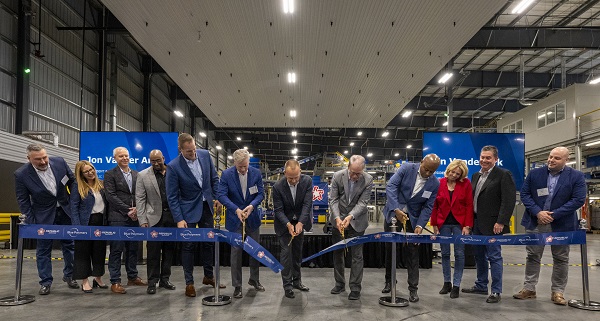
The new Polymer Center was inaugurated with an official ceremony that included remarks by Jon Vander Ark, Republic Services President and CEO; Tim Oudman, Republic Services Senior Vice President, Sustainability Innovation; and Chris Nie, Republic Services Area President, and attended by Willi Stadler, CEO of the STADLER Group; Mat Everhart, CEO of Stadler America LLC; and Jürgen Berger, Head of International Sales at STADLER Anlagenbau GmbH.

“This new facility represents another major step forward in our plans for a nationwide network to close the loop on plastics recycling and help customers achieve a true plastics circular economy,” said Pete Keller, Republic Services Vice President, Recycling and Sustainability. “With the addition of a second Polymer Center we are expanding our processing capacity to produce high-quality recycled resins, contributing to a more sustainable future for packaging in the U.S.”

“The new Indianapolis Polymer Center is a testament to STADLER’s commitment to innovation and excellence in the U.S. recycling industry, contributing to the development of a plastics circular economy,” stated Jürgen Berger. “We are proud of the trust that Republic Services have placed in our company and in our collaborative efforts to drive positive change in the PET and Polyolefins markets in this country,” added Willi Stadler.

A State-of-the-art recycling process to close the plastics circular economy loop

The Republic Services Polymer Center in Indianapolis incorporates a cutting-edge dual-line system designed by them. Bales of mixed plastics are opened using their WireX machine for fully automated wire removal. The materials are fed into the facility and processed separately on two dedicated lines: one for PET and one for mixed plastics, with capacities of 5.5 and 5 tons per hour, respectively.

The process on the PET line begins with mechanical separation and cleaning to remove ferrous particles. A STADLER STT2000 ballistic separator then sorts materials into rigid, flexible, and fines fractions, which undergo near-infrared (NIR) sorting to further separate caps, rings, and labels. The 3D fractions go on to be processed through their Label Remover and Label Separation Hood. Clear PET, caps, and rings are directed to the washing line for granulation and cleaning for reuse, while color PET is compacted into bales.

On the mixed plastics line, materials are first sorted into fines and sieve overflow. The heavier fractions from the overflow are then separated into four polyethylene (PE) fractions –Natural, White, Red/Orange/Yellow, and Other/Color – and two polypropylenes (PP) fractions – Natural/White and Other/Color. PET is recovered from this stream and redirected to the PET line for further processing. The final sorted products are stored in dedicated bunkers before being baled for market distribution.

The linear flow of the plant’s design enhances operational efficiency by improving access to all areas, simplifying maintenance, and incorporating a fully enclosed pre-sort area and a control room with a comprehensive view of material flow and baler operations. The facility also prioritizes workplace quality, offering an open, well-lit environment.

“The Indianapolis Polymer Center is amazing; it might be the nicest looking build-out I’ve ever seen in any plastics plant in the world. The whole installation has a light and airy feel to it, making it a great environment to work in,” said Mat Everhart at STADLER America.

A Growing Partnership for a Circular Economy

Republic Services selected STADLER for the Indianapolis Polymer Center following the successful collaboration on the Las Vegas facility and STADLER’s proven expertise in delivering high-performance recycling solutions. The expansion of Republic Services’ Polymer Centers underscores the growing demand for high-quality recycled plastics in the U.S., driven by both regulatory requirements and consumer preference for sustainable packaging.

This new facility also incorporates additional processing steps to provide Republic Services with greater flexibility in selecting markets for their recycled materials and expanding the range of accepted inputs.

“Our partnership with Republic Services goes beyond constructing state-of-the-art recycling facilities,” concluded Mat Everhart. “It’s about shaping the future of plastics recycling in North America. The success of the Indianapolis plant marks another milestone in our commitment to supporting a more circular economy through advanced sorting technology and strategic collaboration.”

As Republic Services continues to expand its network to close the loop on plastics recycling, they remain a key partner in designing and delivering world-class recycling infrastructure. The Indianapolis facility is expected to make a significant contribution to increasing the availability of high-quality recycled plastics, reinforcing the industry’s transition to a more sustainable future.

https://w-stadler.de/

#W-stadler #Modernplasticsindia #Pasticsnews #ModernPlasticsIndiaMagazine
#Modernplasticssingapore

SUPD Targets at Risk Amid R-PET Cost Pressures

0

SUPD Targets at Risk Amid R-PET Cost Pressures

Since cost-cutting is still crucial in 2025, several firms are reducing the usage of recycled content due to spreads of about €600/ton between virgin PET, food-grade pellet (FGP), and recycled polyethylene terephthalate (R-PET).
With improvements in the free delivered (FD) colorless (C) bale and flake pricing in March, ahead of the start of the peak preform manufacturing season in Q2, the R-PET market has turned bullish in Q1, which might further boost demand for the product.
Meanwhile, PET costs have been rising, but they are gradually being driven down by low-cost imports, which might cause the gap between virgin and recycled materials to expand even more.

Freely negotiated FGP prices for material available on the open market are currently between €1,600-1,680/ton FD NWE, while contact prices – prices linked to feedstock bale and/or flake and usually subject to a formula calculation – have been heard at well over €1,800/ton in some parts of Europe.

This is in stark contrast to the current price of virgin PET which still represents a significant cost saving in comparison to R-PET flakes and pellets.

Several participants in the R-PET market, including beverage brands, have said some brands and fast-moving consumer goods companies (FMCGs) are cutting back their use of R-PET to the minimum contracted volumes, which for beverage bottles is often between 25-30%. This is either to meet the mandatory recycled content target for beverage bottles as set out in the Single Use Plastics Directive (SUPD), which came into effect on 1 January 2025, or in line with internal company targets.

The Coca-Cola Company announced in December 2024 significant changes to its 2030 sustainability goals, in some cases delaying and minimizing targets – which has led to comments from European R-PET market participants that some brands now feel more emboldened to reduce previously announced R-PET content targets, often set anywhere between 50-100%, to a more manageable, and more cost-efficient level.

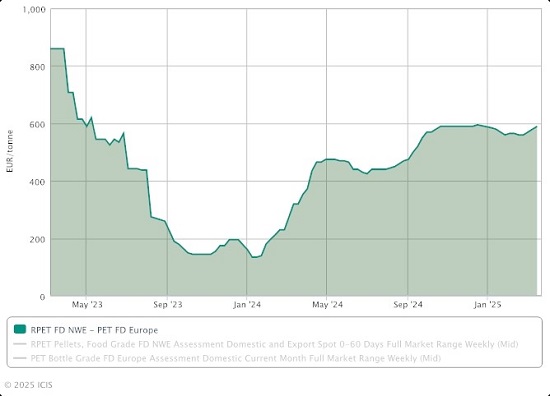
Many brands went big on R-PET content targets at the start of the 2020s after the SUPD was passed in 2019, as shown in the chart below. The spread between R-PET FGP and virgin PET rose significantly from 2019 onwards showing an increased level of demand for R-PET, and though the market has been volatile in recent years, the spread between R-PET and PET remains higher than before the Directive was passed.

Prices peaked in June 2022 but the cost-of-living crisis in 2023 and 2024 saw a much sharper focus on cost savings, and recyclers started to come under much more pressure to try and make R-PET more competitive as consumers in parts of Europe focused more on the money in their wallet than the amount of R-PET in their beverage bottle.

PET buyers entering into the R-PET market for the first time sometimes struggle to understand the relationships between feedstock bale and flake and the R-PET FGP they want to use in their preforms or bottles, with some approaching price discussions based purely on where PET prices are rather than taking into account the cost of production through the R-PET chain.

Member states have yet to put in place any significant financial or economic penalties for non-compliance for brands not hitting the SUPD’s 25% target, leading some PET bottle producers and brands to continue to use the minimum R-PET content, or are even stick with 100% PET until forced to make the change.

This is particularly true of small and medium-sized brands, and particularly in parts of central and eastern Europe, though it has also been noted in other parts of Europe too.

Put simply, many brands do not want to pay high prices for recycled material made from post-consumer plastic waste when they can get prime virgin material at lower prices.

The chart below shows the spread between the midpoint of the FD Europe PET bottle grade resin price and the FD NWE food-grade pellet price, which currently stands at €590/ton.

This reduction in the use of R-PET FGP in particular has resulted in some higher-than-expected stock levels leading some suppliers to offer FGP below market price in order shift volumes or free up working capital.

There is still hope that 2025 will see better FGP and R-PET demand compared with the previous two years, and the annual Plastics Recyclers Show Europe (PRSE) in Amsterdam on 1-2 April will be a good opportunity to gauge the feeling of the market for Q2 and into the rest of the year.

In the days ahead of the key industry event, while there is optimism in the market right now, it might not be at the levels that some FGP and preform producers would like to see for the time of year, especially with the prospect of even lower virgin PET prices on the horizon.

 www.bcmpublicrelations.com
#bcmpublicrelations #Modernplasticsindia #Pasticsnews #ModernPlasticsIndiaMagazine
#Modernplasticssingapore

HASCO’s Z2690/… Delivers Food-Industry-Grade Corrosion Shield

HASCO’s Z2690/… Delivers Food-Industry-Grade Corrosion Shield

HASCO has extended its comprehensive portfolio of chemical agents with a new fully synthetic corrosion protection Z2690/….

The chemical agents from HASCO are noted for their ease of handling, are environmentally friendly and physiologically harmless. Through their high active ingredient content, consumption can be reduced to a minimum, which also contributes to their economic efficiency. In combination with the uniform distribution, the necessary film thicknesses can be applied within a short time.

Reliable protective effect for the storage of metal parts

The new fully synthetic corrosion protection Z2690/… was developed specifically for the indoor and outdoor storage of metals and thus enables the surface quality to be maintained during storage. The spray stands out through its excellent creep properties, which ensure a reliable protective effect even in areas that are otherwise difficult to access.

Easy removal without a cleaner

One special feature of this corrosion protection is the easy removal of the protective layer, which can be done without the use of cleaners. Furthermore, corrosion protection Z2690/…, with its NSF-H1 registration, complies with the strict requirements of the food industry and thus allows its use in sensitive and hygiene-relevant areas.

https://www.hasco.com/

#Hasco #Modernplasticsindia #Pasticsnews #ModernPlasticsIndiaMagazine
#Modernplasticssingapore

Environmentally Friendly Flame Protection for Polypropylene

0

Environmentally Friendly Flame Protection for Polypropylene

Highly active, halogen-free (HFFR) grades are now part of Tosaf’s range as an alternative to flame retardants based on chlorine or bromine, allowing for more environmentally friendly solutions to meet regulatory standards and client demands. FR8719PP is made especially to satisfy polypropylene’s flame-retardant needs in extrusion and injection molding applications.

High efficiency at low concentration

In applications including construction, automotive, and shipping packaging, FR8719PP helps to stop fires from spreading and satisfies strict fire safety standards without sacrificing effectiveness, even at very low concentrations. For instance, after converting to halogen-free flame retardants, PP pipes maintain their high impact strength, dimensional stability, and chemical resistance without any limitations. FR8719 exhibits no long-term migration of the active components, in contrast to many halogen-based flame retardants, and equivalent PP products provide noticeably greater UV protection.

The very good dispersion of FR8719PP in injection-molded and extruded PP-based products is one reason for the very high efficiency of this HF flame retardant. This not only enables a relatively low dosage and therefore the mechanical properties to be largely retained, but also uniform flame retardancy across the entire product. In addition, the low potential for dye build-up (DBU) offers a considerable processing advantage over other halogen-free solutions available on the market.

Broad portfolio of halogen-free flame retardants

The choice of flame retardant depends largely on which UL94 classification is to be achieved. For example, to fulfil the requirements of class V-2, flame retardants in low concentrations are sufficient to eliminate the free radicals formed by the heat of combustion and thus suppress the fire. Only in higher concentrations do they also prevent burning droplets, as required by the UL94 V-0 classification.

They have developed an extensive portfolio of HFFR grades that differ from each other in their flame-retardant systems and fulfil individual priorities to achieve the optimum balance between effect and concentration. Their dosage is between 3 % and 10 % and depends on the desired classification, the type and melt flow index (MFI) of the PP, the thickness of the part and the simultaneous presence of other additives. In contrast, intumescent halogen-free flame retardants require a dose of over 20 % to achieve similar performance.

Expanding the portfolio of conventional flame-retardant additives

In addition to developing new HFFR grades that do not harm health or the environment, Tosaf also fulfils the continuing need for halogen-based products. They combine high thermal stability with high performance to fulfil stringent fire standards without compromising the properties of the product. For example, the brominated flame retardant FR6413PE is suitable for all types of PP pipes, while chlorinated cost-effective flame retardants such as FR0049 can be used for both PE and PP.

State-of-the-art production plant for flame retardants

To meet the growing demand for flame retardants, they have invested in a state-of-the- art production facility. A high-tech laboratory equipped with a cone calorimeter for complete combustion analysis, among other things, is available for testing according to a variety of fire standards. In addition, the company has set up pilot lines that simulate real production conditions and make it possible to taylor flame retardant additives for specific applications.

#tosaf #Modernplasticsindia #Pasticsnews #ModernPlasticsIndiaMagazine
#Modernplasticssingapore
Revolutionizing Mold Cooling with HASCO’s New French System

0

Revolutionizing Mold Cooling with HASCO’s New French System

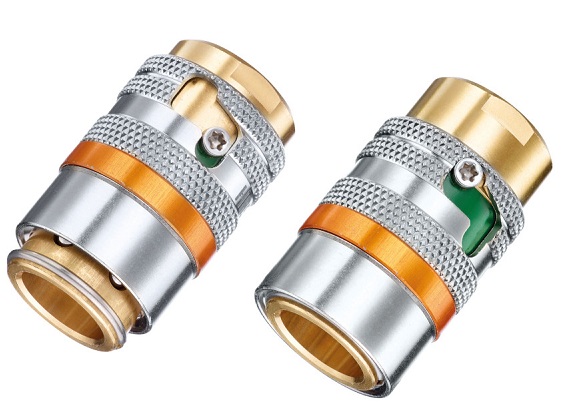
As a pioneer of mouldmaking with over 50 years of experience in the field of cooling technology, HASCO supports tool- and mouldmakers worldwide in the efficient cooling of injection moulding tools. By extending the product portfolio with the new monocoupling system with French profile, HASCO offers even more service for its international customers.

Modular system for maximum flexibility

The new monocoupling system Z 800550ff/… is noted for its blocking function on one or two sides, thereby offering maximum flexibility to meet the demands of precise and efficient mould cooling.

Optimised flow rates and ergonomic operation

A special feature of the new French system, which is available in the sizes 9 and 13, is offered by the special valve technology, which guarantees a minimum flow resistance. Excellent flow rates, which are up to 30 % above the usual standard on the market, increase the performance and ensure more efficient cooling, a reduction of the downtimes and an increase in overall productivity. A further highlight is the ergonomic one-hand operation, which considerably facilitates and speeds up the coupling and separation of cooling circuits.

High-grade materials, a variety of connection options

When developing its monocoupling systems, HASCO opted for high-grade sealing materials that guarantee excellent temperature resistance. The system is designed for use at temperatures of up to 150 °C for water and up to 200 °C for oil. Apart from that, the imperial cylindrical outer threads are equipped with an additional sealing ring to ensure safe and reliable sealing. The monocoupling system also offers variable connections, including inner thread, outer thread and bushing, which enables a high level of adaptability to different cooling circuits.

Comprehensive cooling programme for modern mouldmaking

HASCO offers the most comprehensive range of products for cooling in mouldmaking, extending from nipples and couplings to bushings and hoses. The exceptional diversity of combination possibilities within the range opens up future-oriented solutions for all tasks in cooling technology. With the launch of the French monocoupling system, HASCO is extending its portfolio and ensuring that customers worldwide can have access to the latest and most efficient technologies.

https://www.hasco.com/

#Hasco #Modernplasticsindia #Pasticsnews #ModernPlasticsIndiaMagazine
#Modernplasticssingapore

Cutting Costs & Downtime: PET Recycling Filtration Just Got Smarter

0

Cutting Costs & Downtime: PET Recycling Filtration Just Got Smarter

Short filter service lives and labor-intensive cleaning are no longer an issue

Large-area filtration is stigmatized by high maintenance costs, time-consuming cleaning and switching procedures, and other issues. However, as rPET proportions increase, good filtration becomes inevitable. Therefore, BB Engineering has used its decades of extrusion and filtration experience to address these problems. In addition to meeting the rigorous criteria of recycling operations, the new COBRA filter sets a new benchmark for efficiency, usability, and resource conservation by combining continuous and automated large-area filtration with integrated intermediate filter cleaning.

Large-area fine filtration made for recycling

Recyclers are currently dealing with a dilemma when it comes to filtration. Increasing recycling quotas coupled with insufficient availability mean that lower input qualities are also being considered for recycling, resulting in more challenging contaminants. At the same time, higher-quality applications are being targeted, which further intensifies the requirement for fine filtration. There are systems for large quantities of contaminants, but they do not filter as finely as a candle filter. There are also candle filters that provide excellent filtration but cannot cope with high levels of contamination.

Their new filter can do both. It was specially developed for demanding filtration tasks with high levels of contamination, particularly in PET recycling. Multitasking is the keyword. The filter unites large-area fine filtration with simultaneous, fast and effort-less cleaning, and is therefore able to handle higher contamination rates, which common candle filters would fail on. However, this all-rounder can also be used for other applications, e.g. in synthetic fiber spinning.

Continuity and process stability thanks to automation

As a continuous filter, the COBRA filter has two filter inserts, one of which is always active in production mode and the other either in stand-by mode or in intermediate cleaning. The automated switchover ensures a smooth changeover between the inserts. The status of the filter inserts is constantly checked by the system and, if necessary, their filter automatically initiates the cleaning and changeover process. All the operator has to do is confirm this on the user interface – no further manual intervention is required. The process thus continues to run stably and safely without interruption. Operator-related deviations in the switching process, operating errors or delays, all of which could affect the process, cannot occur.

Effortless inline cleaning – effective and safe

The highlight of their filter is the integration of BBE’s White Filter Cleaning technology (WFC). This process enables absolutely chemical-free and environmentally friendly intermediate cleaning of the filter inserts using hot steam alone and extends the filter’s service life many times over. BBE has already had WFC in its product portfolio as a stand-alone solution for several years. Now, for the first time, the cleaning system is integrated directly into a filter, bringing additional advantages, like cleaning speed and wear-reduction. Production and cleaning become an alternating interaction. Only after multiple operating/cleaning cycles (the ex- act number depends on product and degree of soiling) is it necessary to completely remove the filter insert for a service check and full cleaning. The WFC cleaning process only takes around 10 hours, whereas conventional cleaning takes several days. Filtration and cleaning form a self-contained, automated system that guarantees process and operating safety in equal measure: The operator does not have to handle melt or chemicals.

Development goals: Simplified handling, economic efficiency

BB Engineering pursued clear objectives when developing the filter: in addition to adapting the system to the growing challenges arising from increasing levels of contamination in recycling, BBE focused on simplifying filter changes and cleaning processes through automation as well as significant savings in operating costs.

And that has been successful. Comparing the COBRA filter with other fine filters with a throughput of 2000 kg/h reveals a saving of 40% in pure operating costs. This saving results from various aspects. One significant part of the savings comes from the re-duction of melt loss through backflush-cycles. Another key point is the continuous operation with significantly longer service life thanks to the integrated cleaning with steam. This is linked to reduced use of spare parts and consumables due to the gentle treatment, conversion costs and a lower energy requirement, as no heating and cooling phases and generally lower cleaning temperatures are required. Costs of chemicals are completely eliminated. Automation reduces personnel costs due to the low operating effort and training requirements. In terms of operation, the COBRA filter is also very safe – the closed system of filtration and cleaning without chemicals eliminates many of the risks associated with conventional filters and cleaning methods, such as the risk of injury and fire.

The cost savings are even more far-reaching if you extend the consideration to the downstream processes. The outstanding cleaning performance of COBRA saves a great deal of effort, interruptions and further processing.

The new COBRA filter will be presented to the public for the first time at the PRSE in Amsterdam at the beginning of April.

www.bbeng.de

#bbeng #Modernplasticsindia #Pasticsnews #ModernPlasticsIndiaMagazine
#Modernplasticssingapore
EYEgate HRS: The Durable, High-Precision Solution for Injection Molding

0

EYEgate HRS: The Durable, High-Precision Solution for Injection Molding

The new EYEgate HRS, an improved end ring made for the MULTIflow HRS multi-cavity line, is introduced by Oerlikon HRSflow as industries throughout the world look to maximize productivity and reduce maintenance costs. This creative solution improves performance in a variety of applications and is engineered to provide the best gate quality and longest lifespan.

With a diameter ranging from Ø3.0 to Ø3.5 mm, the new EYEgate HRS ensures a minimal footprint, enabling precise injection point positioning even in complex geometries and hard-to-reach gate locations. A specially designed pin guide system guarantees permanent pin-gate alignment, significantly extending the end ring’s lifespan. Suitable for applications up to 20 g, EYEgate HRS is available for both Sp and Tp nozzle series.

Mold makers can now benefit from a more efficient manufacturing process, as the gate is already integrated into the end ring. This unique geometry simplifies gate area machining, reducing the time required for moldmaking.

Another key advantage of EYEgate HRS is its ease of maintenance. When the gate becomes worn, the end ring can be replaced without re-machining the cavity inserts, significantly reducing maintenance and production downtime costs. This translates to enhanced productivity and operational efficiency.

Designed for industries such as beauty and personal care, beverages, home products, and medical applications, the EYEgate HRS is compatible with a wide range of materials, including: PC, PMMA, PP, PE, ABS, MABS, ASA, SMMA, SAN, thermoplastic elastomers, and most of Sustainable resins.

The streamlined inner profile of the tip enhances color change performance by enabling continuous material flow without stagnation points. This ensures more efficient production processes, particularly in applications where frequent color changes are required.

With its minimal footprint, improved durability, and maintenance-friendly features, the EYEgate HRS defines a new standard for high-performance injection molding solutions, reinforcing Oerlikon HRSflow’s commitment to innovation and efficiency.

www.oerlikon.com/hrsflow

#OerlikonHRSflow #Modernplasticsindia #Pasticsnews #ModernPlasticsIndiaMagazine
#Modernplasticssingapore

PALFINGER Introduces Overload-Protected Tiltable Crane Fork in Europe

PALFINGER Introduces Overload-Protected Tiltable Crane Fork in Europe

The innovative tiltable crane fork from PALFINGER enables precise material transport to great heights  and hard-to-reach areas – ideal for work in tightly built-up areas. For the first time in the European  market, a tiltable crane fork is available that can be fully integrated into the crane system’s overload  function, setting new standards in efficiency and safety. It can be quickly and easily mounted on all  PALFINGER TEC Loader Cranes.

Whether in construction, transport and logistics, or infrastructure projects, many industries face the  challenge of making building materials usable at great heights. With its tiltable crane fork, PALFINGER  now offers an entirely new, innovative solution for the fast and straightforward transport of both  palletized and non-palletized materials directly to their destination, such as upper floors. Thanks to its thoughtful geometry and flexibility, loads can be positioned through almost any opening. Lifting  materials through façade openings like doors or windows minimizes effort and saves valuable time. It eliminates the need for disassembly work on railings or cladding and renders the risky manual pulling of materials obsolete. This advantage enables precise and efficient work, even through the smallest window openings. Temporary platforms or balconies with questionable load capacities are no longer required as drop-off points.

Functional and Flexible in Use

The new tiltable crane fork stands out with its significantly lower overall height compared to other models available on the market. Additional flexibility and safety are ensured by the highly precise hydraulic control of the tilt angle and the integrated strap that secures loads quickly and easily, regardless of their size. The crane fork is mounted on the respective fly jib of the TEC loader crane using the multifunction adapter (MFA) and connected hydraulically. It is compatible with all currently available TEC loader crane models equipped with the PALTRONIC 180 control system. The tiltable crane fork is offered in combination with the proven standard pallet fork upper parts PZP-H and PZP-V, ensuring maximum flexibility and application possibilities.

Setting New Standards in Safety

As the first and only solution on the European market, the tillable crane fork meets the requirements of EN12999, the standard for loader cranes. The specially developed MTCF (Monitor Tiltable Crane Fork) software function integrates the crane fork into the overload system of TEC loader cranes. In case of an overload, the remote control provides an active warning and allows only movements that reduce the load moment. These clear warnings simplify operation, prevent accidents, and protect the crane, thus increasing its availability.

Experience it Live

Interested parties can test the new crane fork directly at PALFINGER or see it in action at the bauma 2025 event in April in Munich, Germany.

https://www.palfinger.com/

#Palfinger #Modernplasticsindia #Pasticsnews #ModernPlasticsIndiaMagazine
#Modernplasticssingapore

Lindner Washtech Appoints New Leader to Steer Company Forward

Lindner Washtech Appoints New Leader to Steer Company Forward

The Lindner Group’s owner, Manuel Lindner, and Harald Hoffmann established Lindner Washtech in the fall of 2013. The company became one of the major players in plastics recycling because of Hoffmann’s idea of creating comprehensive solutions for processing plastics. Since 2023, the company has been in a cooperation with the Erema Group. Georg Krenn became Lindner Washtech’s sole manager in January 2025. As a Senior Advisor Global Sales, Harald Hoffmann continues to be a permanent member of the organization, offering his experience and knowledge.

Lindner Washtech, based in Feistritz/Drau, Austria, and Grossbottwar, Germany, is renowned worldwide for its complete systems that incorporate the shredding, sorting, washing and drying of a wide range of plastic types. An industry leader with more than 200 washing systems installed around the world, in the past few years the company has predominantly focused on optimizing the process along the value-added chain and new concepts for cleaning methods. With the goal of optimizing the entire process chain in plastics recycling, a collaboration was initiated with the Erema Group, an industry leader in the extrusion of polyolefins. The close cooperation between Lindner Washtech and Erema since the start of 2023 has already produced significant process optimizations.

Besides the technical progress, a new chapter has also begun at Lindner Washtech at the managerial level. Harald Hoffmann, founder, visionary and driving force, passed on sole management of the company in January 2025 to Georg Krenn, who has been Managing Director at Lindner Washtech Engineering for the past 10 years. “In Georg Krenn, the company gains an experienced manager who has worked at Lindner Washtech since the very start. As Head of the Research and Development department he co-developed a substantial part of our product portfolio and knows our customers and the global recycling market extremely well,” Harald Hoffmann explains. Hoffmann himself will be supporting customers around the world together with the sales team and continue to advance Lindner washing systems and lines with regard to process optimization, equal- and upcycling. “Harald Hoffmann has sustainably shaped the plastics industry with his ideas and strategic direction, driving the positive development of the brand,” says Manuel Lindner, owner and recycling pioneer for the company of the same name. “We are delighted that Harald will continue to be a permanent part of our team with his expertise and knowledge of the market in his role of Senior Advisor Global Sales.”

Hoffmann responds: “I would like to particularly thank Manuel Lindner for the confidence and trust he placed in me. This success story would not have been possible without this support and without our wonderful colleagues. The Erema Group’s contribution further strengthened the company. I look forward to keeping in contact with our customers as part of my new role,” says Hoffmann.

www.lindner.com

#lindner #Modernplasticsindia #Pasticsnews #ModernPlasticsIndiaMagazine
#Modernplasticssingapore

Bay Plastics Machinery Reinforces Service Excellence with New Hire

Bay Plastics Machinery Reinforces Service Excellence with New Hire

McKenna Forgash has been appointed as the rotor sales representative for Bay Plastics Machinery, a pelletizer provider.
Forgash will play a vital role in BPM’s feedroll recovery and rotor sharpening services in this capacity. To keep client operations operating efficiently, she will assist with the pickup and drop-off of rotors, higher feed rolls, spare parts, and other necessary components.

To help plastics processors keep their pelletizers cutting at peak performance, BPM offers BPM Fast Track. With this service, Bay picks up rotors from customers’ facilities, sharpens them, then delivers them back to customers in two weeks. They also provide feedroll recovering services, restoring customers’ worn rolls with BPM InduraMaxx coating in two weeks or less.

The Bay Plastics van is on the road weekly throughout the Midwest, picking up and returning rotors and feedrolls to customers. For areas throughout the country not covered by the mobile service, customers are required to ship their rotors and feedrolls to BPM. “Our success on our western route has proven how valuable this service is, leading to the expansion of a new eastern route through Michigan, Ohio, Kentucky and Tennessee,” McKenna explained. “With this growth, the goal remains to ensure customers get what they need when they need it.”

Before joining the team, Forgash spent two-and-a-half years in sales in the uniform and forklift industries. She earned a bachelor of science in psychology from Wayne State University.

McKenna represents the fourth generation of the Forgash family to work at what is now Bay Plastics Machinery. Her great-grandfather, Tony Forgash Sr., founded JETRO in Bay City, MI in 1961. Her grandfather, Tony Forgash Jr. led the company through many years of growth and founded Bay Plastics Machinery in 1997. Today, McKenna’s father Jim is Vice President of Sales, and her uncles, Jason and Jeff, are President/CEO and Vice President of Sales, Parts and Service at the company.

“One of my job’s better perks is that I get to travel and meet new people. I am excited to start this new journey and build strong relationships with our customers while helping them keep their operations running smoothly,” she said.

https://bayplasticsmachinery.com/

#bayplasticsmachinery #Modernplasticsindia #Pasticsnews #ModernPlasticsIndiaMagazine
#Modernplasticssingapore